
Trace Wicomico County Former Owners from the Newest Deed
Begin with the newest recorded conveyance and read the chain backward. Each deed names a grantee who received the land. It also names a grantor who gave it up. The grantor then becomes your next target. Search for that name as a grantee in an earlier deed. Repeat the hop until the chain runs out. A street address can change over the decades. The legal description does not. Subdivision and lot, map-grid-parcel reference, and the liber/folio citation all help. They keep the land itself in view the whole way.
| Backward step | Name relationship | Record clue | Result to preserve |
|---|---|---|---|
| Current conveyance | Present grantee from prior grantor | Deed date and liber/folio | Exact legal description |
| Earlier acquisition | Prior grantor searched as grantee | Earlier deed book and page | Previous owner and parcel wording |
| Parcel changed | Names may cover a parent tract | Recorded subdivision plat | Lot, block, section, and road status |
| Pre-county era | Chain may cross jurisdictions | Somerset or Worcester books | Older tract and party references |
Use the free MDLandRec index and image service for the recorded sequence. Move to the Clerk or Archives when a citation, index run, or image is not online. The SDAT card supplies leads, but it never replaces the deed chain.
Wicomico County Transfer Entries Are Clues, Not a Complete Chain
The Maryland SDAT detail card can display transfer dates and prices. Arms-length labels, deed references, and assessment history also appear there. Those fields point quickly to possible former owners and useful recording citations. They can also mislead when read alone. A typical Wicomico card may pair a 2022 non-arms-length entry at $0 with a 1992 arms-length transfer at $68,900. A 1991 $0 entry may appear too. A zero-dollar line never explains itself. It could mark a family conveyance, estate transfer, entity change, or correction. Open the cited deed and read the parties, consideration, legal description, and execution language. Treat the SDAT classification as an index clue, not the conclusion about why ownership changed. Note: A sale table can omit instruments that still matter to a title history. Corrective deeds, releases, and later parcel changes may be left out.
MDLandRec Opens the Wicomico County Deed-Book Route
The Maryland State Archives service requires a free account. After login, it opens public index and image navigation for Wicomico County deed books. Do not assume a single online cutoff year. Do not promise index fields you have not confirmed. The MDLandRec access page shows the login, account-creation, and index route. Use it for starting a Wicomico County property search.
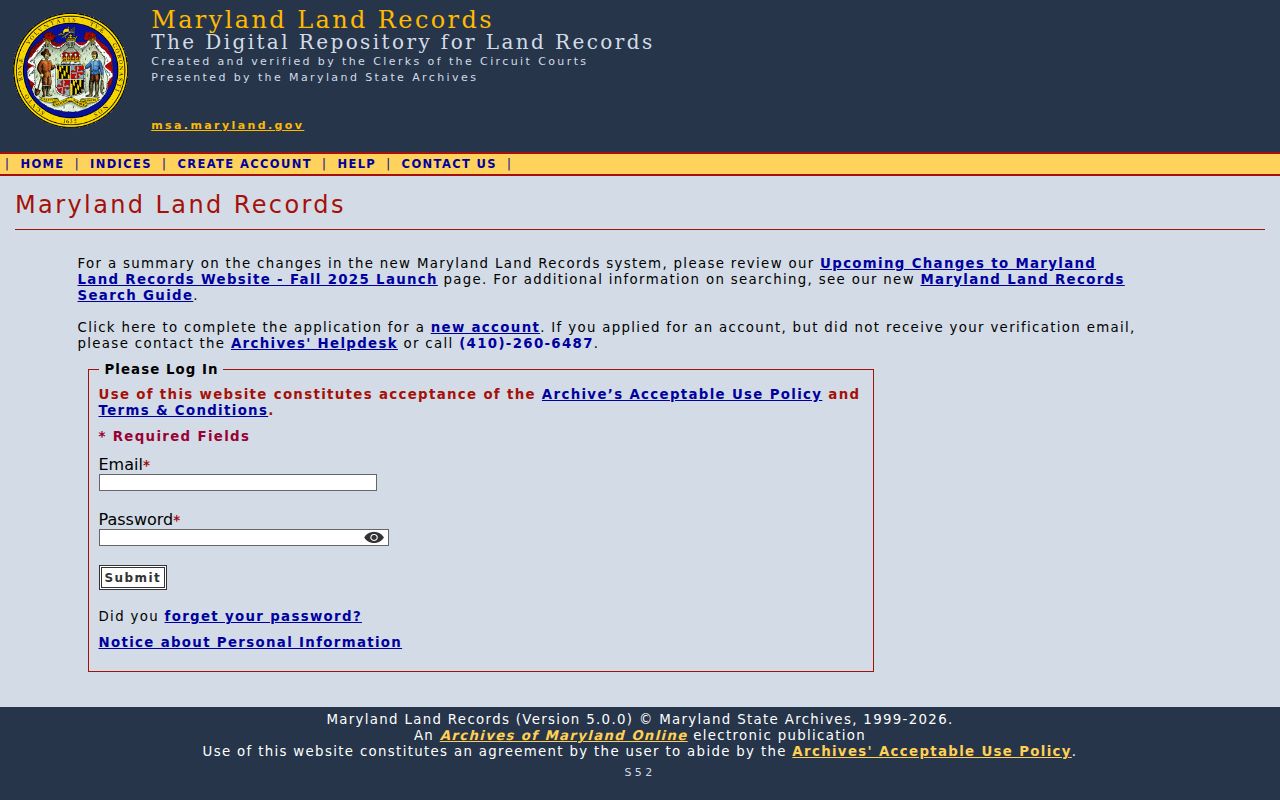
Once inside, write down each index result and image citation before stepping back another transfer. If an image or index run is missing, take the known book and page to the courthouse or Archives. Never guess at a prior owner.
Walk Wicomico County Ownership Records Backward
Build a transfer worksheet with one row per instrument. Record the deed date, recording date, grantor, grantee, and deed type. Note the liber/folio, consideration, and full legal description too. Then compare each new row with the row above it. A repeated lot and plat can hold the chain together. This works even when the street address or a party's spelling changed between deeds.
- Find the newest deed and copy both parties, the recording reference, and the land description.
- Take that deed's grantor and search for the instrument by which that person or entity acquired the same land.
- Match the parcel through lot, block, subdivision, acreage, plat, and adjoining-land language, not merely the street.
- Repeat until the online index ends, then carry the last reliable liber/folio and names into the deed books or Archives.
- Grantor
- The party conveying an interest in the recorded instrument.
- Grantee
- The party receiving the interest. In a backward search, that name leads to an earlier acquisition.
- Reverse index
- An index organized by grantor, useful when following ownership away from a known deed.
- Warranty and quitclaim deeds
- Different forms of conveyance whose effect must be read from the actual instrument.
Recorded Plats Explain Breaks in Wicomico County Former-Owner Searches
A former owner may have held a larger parent tract before it became today's lot. SDAT can display the subdivision, plat, lot, and deed references. County GIS fields may add plat liber/folio and section. They may also list block, map, grid, parcel, zoning, and subdivision descriptions. The recorded plat is the key record. It shows how parent land became separate lots. Compare the SDAT wording with the county GIS abbreviations. Then compare both with the official plat image side by side. Leading zeroes, shortened subdivision names, and a later resubdivision can look like conflicts. They may still describe the same land. Plats.net is the Clerk-linked destination. If its live screen is unavailable, fall back on the Clerk and Archives plat holdings.
Wicomico County's 1867 Line Sends Older Research Elsewhere
Wicomico County was formed in 1867 from land that had belonged to Somerset and Worcester counties. The Archives electronic land-record collections begin with county-era material. Individual index series, though, have different date runs. So 1867 is a jurisdiction clue, not a universal online cutoff. When the chain reaches a deed predating the county, follow the legal description and parties into the right predecessor county. The Maryland State Archives Wicomico land-record series and its combined inventory help identify deed, lien, plat, and related collections. Preserve any gap you find. Never join two similar names without an instrument.
Courthouse, Archives, and Library Channels Extend the Wicomico County Chain
The Wicomico County Circuit Court Clerk's Land Records office at 101 North Division Street, Room 105, Salisbury, is the recording authority. It offers courthouse access. The land-records telephone is 410-543-1427. The statewide land-record guide describes courthouse terminals and clerk help when a book and page citation is known. Staff do not perform title searches. For deeper context, the Maryland State Archives holds deed and plat series. These include Wicomico plat microfilm from 1867 through 1950. The Nabb Research Center and Wicomico Public Library's Maryland History Room add maps, directories, land-record microfilm, house histories, and newspaper indexes. Those sources can corroborate a former owner's tie to a place. The recorded instrument remains the ownership source. Note: Historic maps and directories help explain changing street names and buildings. They do not substitute for a deed or recorded plat.
Estate Records Can Bridge a Wicomico County Ownership Gap
A deed chain that runs cleanly from buyer to seller can snap when an owner dies. A personal representative may also sign for an estate. Wicomico Register of Wills records help here. An estate file can yield a number and a status. It can also point to who held authority. What it cannot do is prove that this particular parcel passed to a particular heir.
Treat the estate clue as a pointer, not a conclusion. Take it into the Clerk's land records. Pull the personal-representative deed or whichever instrument was actually recorded. Then match the deed's legal description against the SDAT account and the earlier conveyance. That way probate authority and title evidence each stay in their lane. A same-name estate result never gets mistaken for proof of ownership.
Audit Wicomico County Prior Owners by Land Description
Names make weak links in any Wicomico County title search. Initials change, entities and trustees intervene, and estates blur the parties. The land description is the stronger thread. Compare acreage, metes-and-bounds calls, adjoining owners, subdivision, lot, block, section, plat, and liber/folio from one deed to the next. Remember that a street address can be newer than the deed book itself, so it is the parcel description, not the house number, that carries the backward chain through address changes.
How Far Back Wicomico County Former-Owner Records Reach
No single cutoff governs every Wicomico index. MDLandRec coverage varies by index and series. Archives electronic collections carry differing dates. And the county itself did not exist before 1867. Older research can still proceed through bound or imaged deed books, the 1867-1950 plat microfilm, predecessor-county records, and the Maryland Land Office's patent, certificate, survey, and plat collections.
Where should the search stop? At the last instrument that can actually be matched to the land, never at the oldest same-name hit. If the chain will not join, record the missing book, page, date, party, or image as a research gap. When legal rights hang on an unbroken chain, a professional title examination is the right call.
Use the trail with care. Former-owner research supports house history, estate work, and property diligence. It must not be used to stalk, harass, intimidate, or harm a living person.